
notes from the carnival
on thrifting costumes, self-knowledge, and making art when you can't make things

I wasn’t planning to go out, the first night of the carnival. This year was supposed to be quiet. It was mid-semester, and I had a book to write,, and two dozen interviews to conduct – this year, carnival is a field site. If carnival in Venice is, as tradition dictates, a time to give in to one’s rarely-satisfied desires, my most rarely satisfied-desire, that Saturday, was to stay in bed and re-read To the Lighthouse.
I’d arrived in the afternoon. I’d had lunch, gone halfway across the city to buy a new notebook at the only shop that makes the marble-paper notebooks I like and keep on a neat and visually-pleasing shelf in my study,, found them discontinued (they stopped making the needles this particular man needed to marble the paper the particular way he liked.. I have been writing for a year and a half now in notebooks from this one man’s shop. I have never written fiction more consistently than in this man’s marbled notebooks. I found, after some failures, a different shop, and a different notebook, and anticipated that this augured some kind of sea-change in my life. This notebook, only slightly smaller, can fit in a going-out purse. In any case I still planned to stay in. Then I stopped by the flea market in Santi Giovanni e Paolo and saw a pair of drawstring toreador pants hanging in the doorway, for sale for twenty-euro, cash, and then I had no choice but to get dressed and go meet everyone at Cafe Florian.
I’m not a costumer. I can’t sew. I can’t even sit still long enough to watch a sewing tutorial on YouTube. The kinds of skills required to make a historically-accurate, geometrically-precise, perfectly-tailored, exquisitively-crafted costume (which I think are also the kinds of skills required to be a fully-realized person) are the care, the attention to detail, the work of the hands, the stillness, that baffle my instincts. I have somehow, over the past nine years, ended up an enthusiastic interloper at an annual gathering of people who have the exact qualities I lack. I am always late, always in a rush, always distracted. I always show up to Florian with at least one bobby pin visible and one piece of my costume hanging off. “My dear,” this well-intentioned French vendor of antique military garb told me once, “there eez always something wrong with you.” Imagine this in the most extreme accent you can.
Earlier years of the carnival, when I was more afraid of my friends than I am now, I would try much harder to look like I belonged there. There is nothing more ungainly than a person trying to ape elegance. I have looked halfway decent in costumes bought secondhand from friends. But I have rarely felt comfortable. Usually I feel like a clown masquerading at court.
I have worn costumes at carnival that tried in vain to conceal this – stays and panniers and wigs from which my hair was constantly emerging. I’ve tried, too, costumes that instead inadvertently revealed my most pathetic parts. One of the most bittersweet costumes I ever put together was that a broken, lovelorn Toy Soldier, who had a knack for inviting misfortune from the universe. The last time I wore it, I walked home alone from a party at five in the morning, a woman randomly threw a bucket of water out her window and it all landed straight on my head. But being the first to make a cutting joke about yourself is not the same thing as being able to laugh at yourself properly.
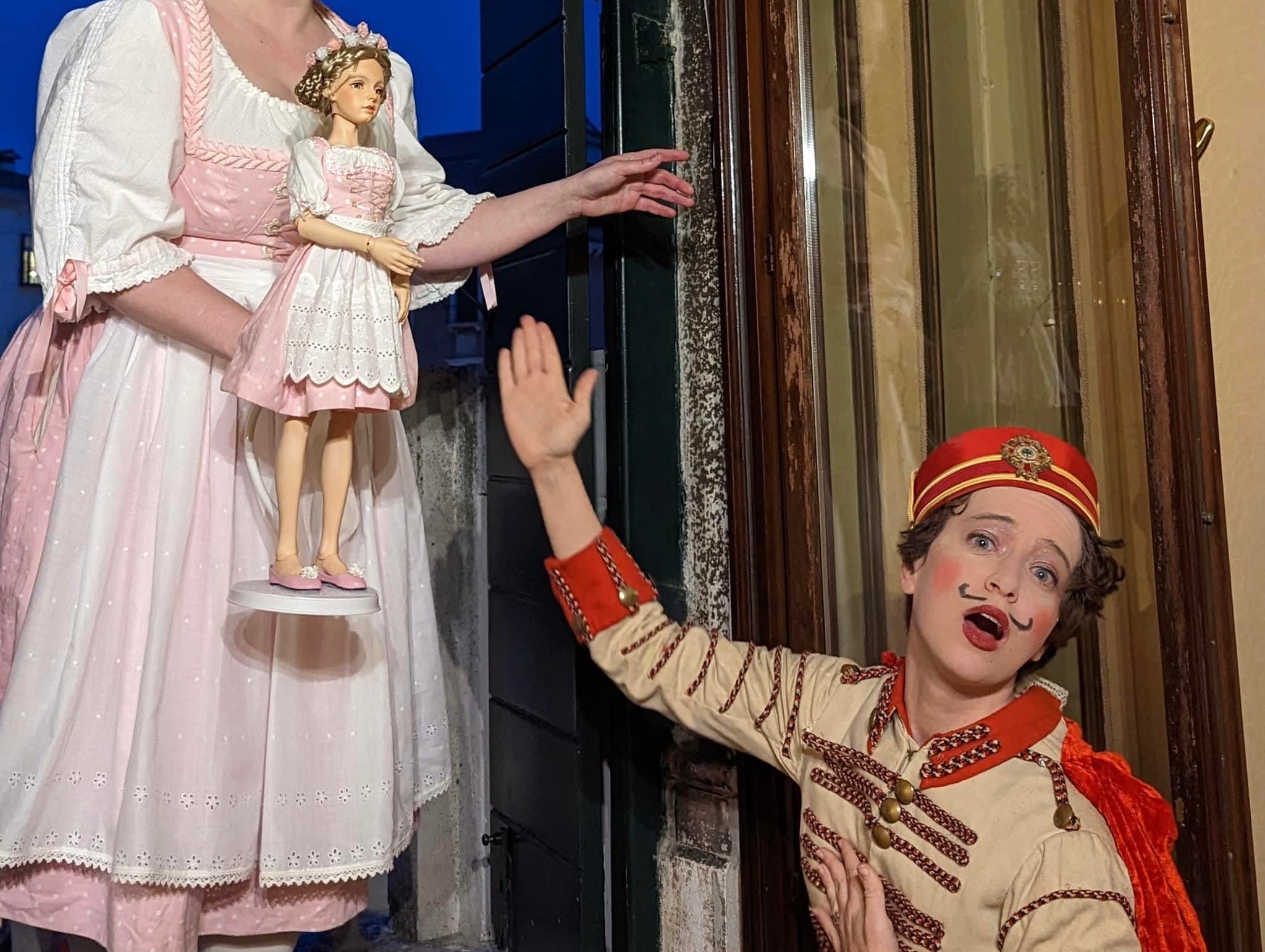
If there’s anything that has changed my mind about “authenticity,” over the past few years -- and made me far more appreciative of it as a meaningful and even moral quality (pace Charles Taylor) it’s carnival. There is something (as I’ve written before) about the right costume on the right person -- and the more time I spend at carnival the clearer it is that the right costumes are those that can only be worn by the person wearing them -- that is informed by, but not reducible to, the width of someone’s shoulders, or the line of their waist. Some people can pull off being Marie Antoinette, and other people can pull off being a toreador, and other people still can pull off being a lemon.
Traditionally, carnivals are about otherness. You cross-dress, or play a prince if you are a peasant; you hide your face; you do what you will. But nobody at the carnival I go to ever wears a mask. And not a single person I talked to, in twenty-odd interviews, said anything about costumes letting them pretend to be somebody else. Everyone differed -- far more than I’d expected -- in what it was that had first brought them to beauty: Directoire fashion, red lipstick, leather shoes, Wonder man, eighteenth-century country-style (not – he clarified – urbane) Central European furniture. But on this everyone agreed. Your carnival costume was who you truly were.
Anyway, those trousers. I just plain liked them, the same way I just plain liked those particular marbled journals, which were only a little bit different from the marbled journals you get across every Venetian bridge. They looked theatrical. They looked comfortable. They had a drawstring. They.reminded me of something.
On a whim I’d brought in my suitcase a black velvet bodice -- bought for the same price at the same market a year earlier. I hadn’t planned a costume around it; I’d just somewhat panickedly thrown it in at the last minute, “just in case,” along with a silk blouse whose cuffs were ripping, a yard or so of gold fabric I’d found at a church sale, an Indian scarf – a years-ago gift – I’d stuffed in while carting my suitcase to the front door of the apartment. I had this hat wth me I’d gotten at a thrift store in Providence, firm enough in its wiring that I’d successfully twisted in into a tricorn a year ago.
It was about this time that I figured out who I wanted to be. It was a painting I’d fallen in love with -- and written about – at the Met, a year or so ago. It was Manet, painting his mistress Victorine Meurent as an imitation Spaniard...
I untwisted the tricorn and made it into an imitation bowler. I cut the gold fabric with kitchen scissors and made it into a bandana. It wasn’t quite right -- Victorine has a jacket; I only had a bodice. I had a real red cape instead of her ironic pink silk one. But I felt like myself. And so I went out.
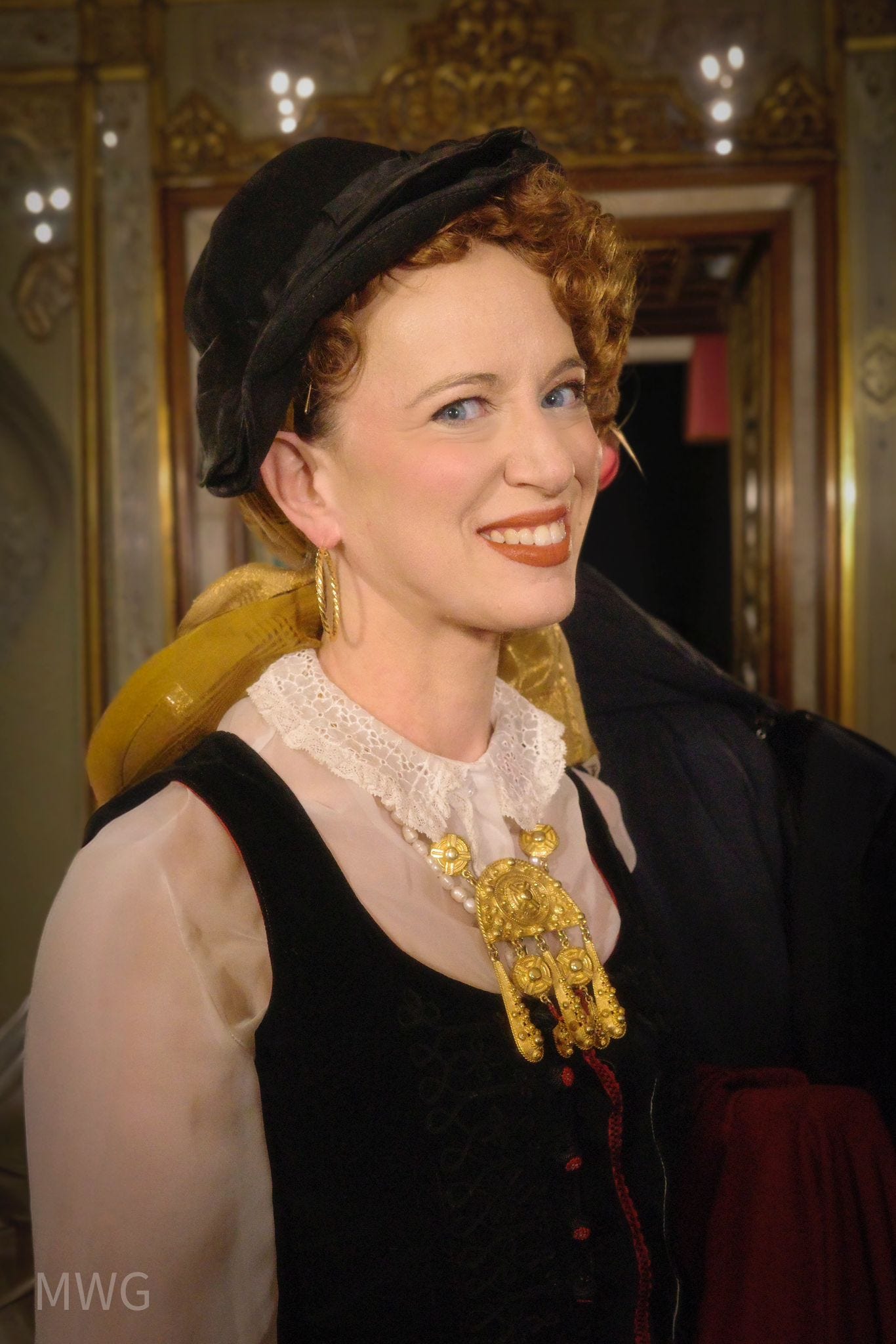
I don’t know why this made me as happy as it did. If there’s anything I’ve learned at the carnival, it’s the childhood strangeness of our desires: the perplexing affinities, no less baffling than fetishes, that we have (why Wonder Woman and not Catwoman? why eighteenth-century Swiss country furniture and not city furniture?) There is something in me that loves the manic energy of scrabbling through a dressing-up box and coming up with a costume, like I’m a fin de siecle French actress with a ramshackle company. I love having strange little adventures and finding strange little bits of fabric and odd costume pieces and then in a last-minute fit of inspiration, figuring out how they all fit together. This too may have a mysterious childhood origin: my mother has photos of me, aged nine or ten, doing the exact same thing for Halloween.
“The raccoon goddess of carnival,” a charitable friend called me. I’ll take it. A blunter Russian friend of mine, who spends eleven months painstakingly sewing about twenty new costumes a year -- ten for her, ten for her husband -- put it less softly. “The rest of us, we spend all year preparing, sewing. And you –,” she pantomimed a decidedly procyonid scrabble in a suitcase. “At five o’clock, you ask yourself: ‘who do I want to be today?’ I never know how you are going to turn up.” (Eighteenth-century, she informed me, a day later, doesn’t suit me. Seventeenth-century works much better.)
Still, somehow (by God’s grace; by other people’s kindness, by my Russian friend, who hand-repaired the cuffs on my torn blouse one afternoon), I belong here. I’ve never fully understood why. I am surrounded, constantly, by people who are good at all the things that I am terrible at, who think in care and colors, who can sew buttons, who notice the difference in fabrics, who have a capacity for attention that constantly eludes me, by people who are elegant in exactly the way I struggle most to be.
And yet, I found -- for the first time, in nine carnivals -- a version of myself, in costume, in which I felt entirely myself. It wasn’t just the thrifting, or the pinning-together of fabrics (repinned, more expertly, by a professional corsetiere in a hotel bathroom). It was, rather, the recognition of a mutual joy in what the people I interviewed called -- not beauty, as I’d expected -- but creativity: a creativity that sometimes required skill and sometimes money and sometimes an eye for fabric and sometimes hours of research and sometimes required a body that looked best when wearing almost nothing but which demanded, above all else, both enough self-knowledge to know your limits and enough pride to bend them, a little.
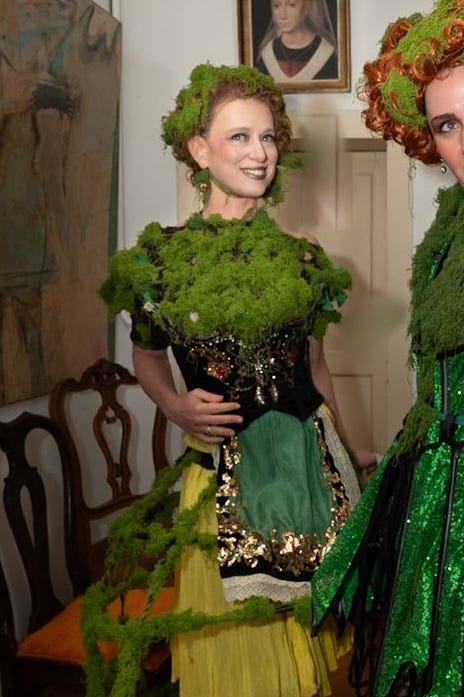
Somewhere between that first Saturday and the end of the carnival the following Tuesday I re-designed most of my costumes. I did not, of course, learn to sew in the allotted time, nor did I develop an artist’s eye for form. But I let myself take joy in the smaller, more playful acts of creation. I’d lost a necessary portion of a “French garden” party costume in transit -- I was supposed to be a topiary -- and at the last minute realized I could create it better with a ripped mesh top from an underwear store and three bags’ worth of fabric moss, painstakingly tied through the holes.
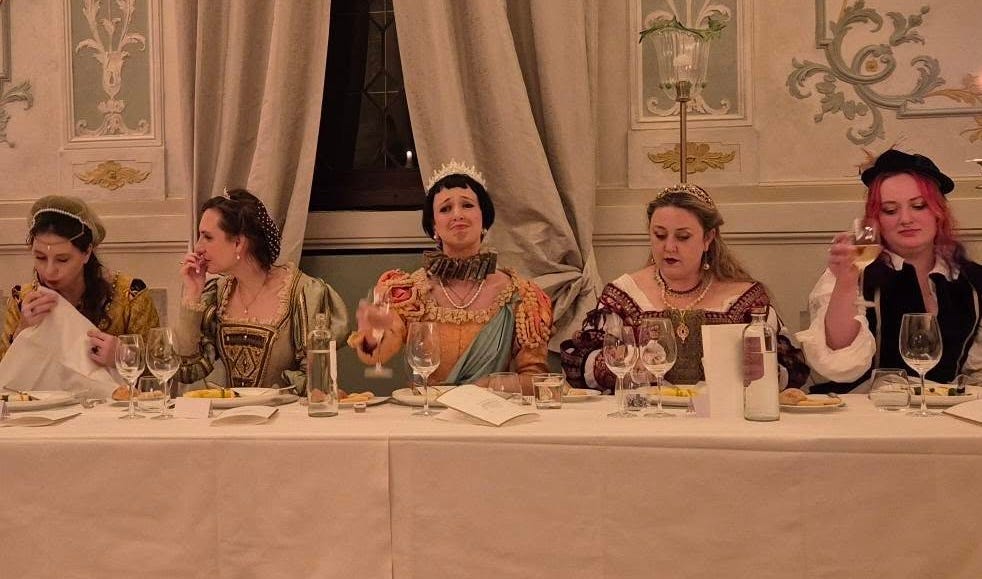
For a “Shakespeare” party, I decided a day beforehand to scrap my original idea (standard-issue Viola in Renaissance boy drag) and instead add a layer to the drag by being an Elizabethan boy-actor playing a tragic Shakespearean queen, and spent several scrambling hours before the party making a reasonably-good approximation of a Renaissance ruff with Venetian marble paper I liked, from the store where I’d at last decided to buy my replacement journals from now on. It took about a hundred staples, and some spare ribbons. I added a mustache on my way to Florian by way of some eyeliner a sympathetic pharmacist en route decided to give me for free, so long as I promised to come back with pictures.
None of these costumes, of course, were “good” the way that the costumes of people I admire were good. But I can say, I think, that I have never worn any costumes better. I like to think that even my Toy Soldier — had I brought him to Venice this year — would have had a little swagger.
And I ache, still, for whatever capacity for attention makes you make things well -- real, tangible things -- because it is easier to fake a bad sentence than a bad seam, and it is also true that if a genie emerged from the Grand Canal and offered me that power I would use it to read books more closely, and write better ones. Maybe it is not such a terrible thing, to have an immaterial craft, although at the carnival it is easier to think of my writing -- of words in general -- as one way of perceiving the world as among many.
But, at least, the fact that I can’t thread a needle to save my life, that the work I do so rarely enters the realm of the material, does not disqualify me from the joy of seeing a pair of twenty-euro trousers in a thrift store, or ruff in a sheet of Venetian marbled paper, or a topiary in a mesh underwear top, feels like a kind of mercy. We take what is and turn it on its head. It is, after all, the work of metaphor: to attest to the unexpected connections between things.
“Most people at the carnival,” said this one French playwright I have known for years, over a drink at Florian that started out as my interviewing her and turned into her interviewing me, “they are looking for a path towards others.” By which, she explained, their goal was to impress, to attract, seduire.. “You and I” -- maybe because we were both writers, she suggested -- “we are looking for a path towards ourselves.”
And maybe this is not so bad, to be someone who can’t sit still, who wants so badly to get the right marbled notebook that she crosses Venice straight off a nine-hour flight for it, who loves to pop into over-full stores and find twenty-euro treasures, who loves throwing together costumes where every object of clothing is a memory, where everything I have ever done or experienced and every place I have ever gone and everyone I have ever loved can somehow be commemorated, and reconfigured into something with structural unity and aesthetic cohesion, and I want nothing more, when I am putting something on my body, to find a way to put everything I have ever experienced together into a kind of artistic unity somebody else can apprehend.
Three days after carnival ended, I started work on a new novel.
Sometimes really do you have to just be who you are.
You listen to your desires long enough, at a festival predicated on desire, and you really do learn something. I learned that I like to make ruffs on six hours’ sleep, with three hours’ notice, and that a recorder should probably be part of all my costumes, going forward, and also that I write better, the week after, and also that I too should spend more of the eleven non-carnival months obsessively doing what I love.
It’s all material. Even Venetian paper.
Earlier this month, on Super Bowl Sunday, I ran into an old friend in my neighborhood; he was on his way to a Super Bowl party and I was on my way to the library (I had editing to do and figured the library would be especially quiet and empty that afternoon!). I was a little embarrassed, because I felt like "going to the library during the Super Bowl" is kind of "parody of myself" behavior, but my friend saw it differently: he was impressed that I am "always so true to who I am." Lately I've been feeling a little lost and like the world has gone mad, so it really helps to think that perhaps my anchor in these times, can be to lean in hard to who I am and have always been. Better a self-parody than an ill-fitting mask -- and maybe it's not even a parody, but a pure distilled truth.
"on a neat and visually-pleasing shelf in my study"
Things to aspire to. And i was put in mind of Brodsky as you described your rush from plane to stationer -- I was standing there waiting for the only notebook i knew in that city to meet me. She was pretty late.